Snake Typing Game
Four words sit around the board, one per direction. Finish one and the snake turns that way.
NO BEST YET — PLAY A ROUND
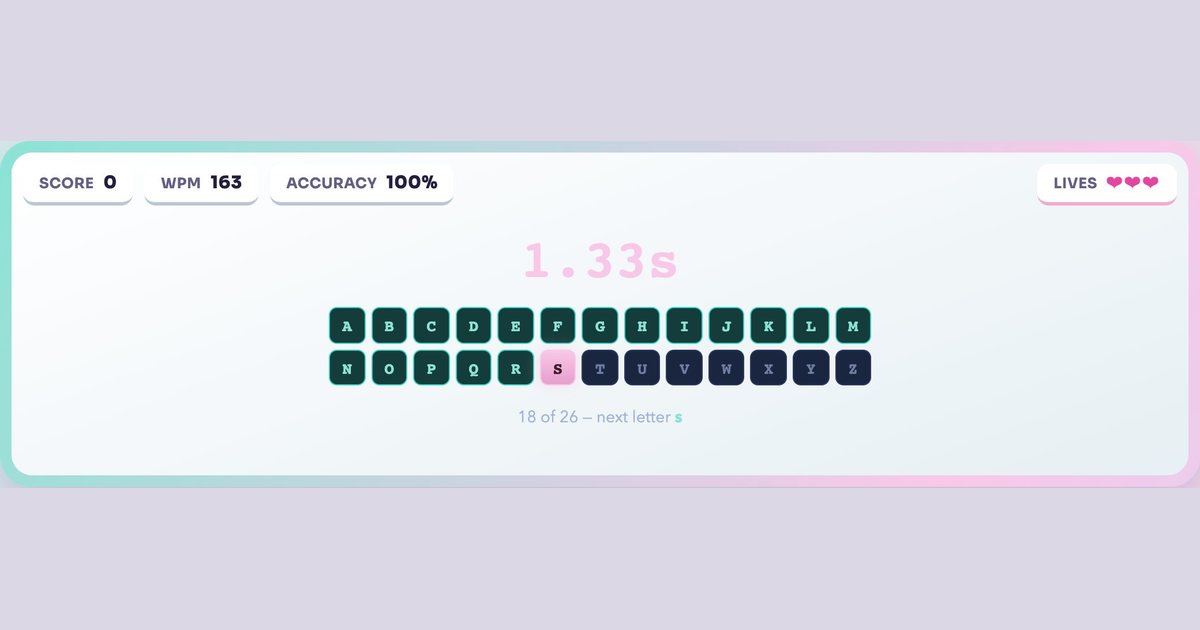
Twenty-six letters, one clock. Type the alphabet in order as fast as you can — the timer starts on your first letter and stops on Z. Three wrong keys end the run, so a clean pass beats a frantic one.
Last updated:
The trick is that the alphabet is not a word, so whole-word muscle memory gives you nothing. You are typing 26 keys with no rhythm to lean on, which is exactly why the letters you rarely use — q, j, x, z — cost you most of your time. Watch the clock on a run and you will see it stall in the same two or three places every time.
The fastest approach is to break A–Z into chunks you can fire as bursts: abc, def, ghi, and so on. Typists who beat ten seconds are not moving their fingers faster than everyone else; they have stopped searching between letters.
Rough bands from the way people actually perform on this challenge: most beginners land between 8 and 15 seconds on a first attempt. Comfortable typists settle around 5 to 7 seconds. Under 5 seconds is fast, and under 3 seconds is exceptional.
For reference, the Guinness World Records mark for typing the alphabet is 3.37 seconds, set by SK Ashraf in Telangana, India, on 10 October 2017. If your first run is 12 seconds, that gap is not talent — it is the search time between unfamiliar keys, and it shrinks quickly with practice.
For someone still learning where the letters live, this is the most useful drill on the site, because it forces every single key exactly once. Nothing else does that — normal typing practice lets you go weeks without pressing a q or a z on purpose.
As a pure letter typing game it doesn't get simpler: there is no reading and no vocabulary involved, so a six-year-old who knows the alphabet song can play it. The letter tiles fill in as you go, which turns the alphabet game into a visible progress bar rather than a test — and makes it a natural first abc game on a real keyboard.
An alphabet time does not convert to WPM in any meaningful way, and you should not read it as a typing speed. Real typing is made of common letter pairs your hands have learned as single motions; A–Z is deliberately the opposite, an order English never produces.
What it does measure is raw key knowledge — whether you know where every letter is without looking. That makes it a good 20-second warm-up before a longer session and a good way to find your weak keys, but for an actual speed number use the typing speed test instead.
Earn badges as you play — they save on this device, or sign in to keep them on every device and join the leaderboard.
Snake Typing Game
Four words sit around the board, one per direction. Finish one and the snake turns that way.
Dance Mat Typing
A twelve-stage home row course in four levels. The next key you need lights up as you go.
Hangman Typing Game
The classic word guess, played from the keyboard. Six wrong letters and it's over.
Guinness World Records lists 3.37 seconds, set by SK Ashraf in Telangana, India, on 10 October 2017.
Under 5 seconds is fast and under 3 is exceptional. Most beginners start between 8 and 15 seconds, and comfortable typists sit around 5 to 7.
Indirectly. It drills key location rather than the letter pairs real typing is built from, so it works best as a warm-up and a way to find weak keys — not as a substitute for typing actual words.
Yes. It needs no reading or vocabulary, only the alphabet, so it suits children who are still learning the keyboard. Tiles fill in as they go so progress is visible.
The run survives two mistakes; the third ends it. The clock keeps running through a mistake, so accuracy is genuinely faster than mashing.
Yes, in your browser. Sign in with a free account if you want it to follow you across devices and appear on the leaderboard.
Yes — free, no download, no account required and no ads.